The Longevity Letter #15: Is 50% of your lifespan already "decided"?
A major new study reveals that over 50% of your lifespan is genetic—but here's why that actually validates precision medicine.
Hi ,
Last week, I sat on a panel discussing “The Rise of the Provider-Influencer.” My perspective is simple: in an ecosystem flooded with health advice, our real job isn’t just knowledge transfer or motivation—it’s interpretation.
Then this week delivered a perfect example of why that matters.
A major paper in Science landed with a headline that felt quietly demoralizing: human lifespan may be more than 50% genetic—roughly double the estimate most of us have been operating under for decades.
If that’s true, it brings up feelings of futility. If so much of longevity is predetermined, how much do our protocols, habits, and interventions really matter?
But once you actually read the data—and understand what changed—you realize this isn’t a loss of agency. It’s a clarification of the playing field.
This research doesn’t say effort is futile. It tells us where effort actually works.
Let’s unpack it.
The TL;DR if you only have 30 seconds:
🧬 The “50% Genetic” Finding Is Not Defeatist A new Science paper estimates lifespan heritability at ~55% after removing historical noise (infection, war, accidents). That doesn’t mean lifestyle doesn’t matter—it means aging is a structured biological process, not random decay.
🏋️ Exercise Can Reverse Age—but Only at the Right Dose A Nature Aging study shows that meaningful reductions in biological age require intensity, not just movement. Heavy resistance training and high-intensity cardio moved proteomic aging markers. Casual activity did not.
⚡ Quick Hits: Reset, Relapse, and Red Flags We’re seeing the first FDA-cleared age-reversal trial, confirmation that progress made with GLP-1s can whiplash backwards, and growing scrutiny of consumer tests that measure far more than they can meaningfully act on.
Let's dive in.
🧬 Is 50% of Your Lifespan Genetic? (And Why That’s Actually Good News)
For decades, the "official" number was comforting: genetics only accounted for about 15% to 25% of human lifespan. The rest—the vast majority—was supposedly up to lifestyle, environment, and luck. It was a blank slate narrative that felt empowering.
But a landmark study published this week in Science has shattered that estimate.
By correcting for historical "noise" (like infectious diseases and accidents that killed people before they could age), researchers have recalculated the heritability of human lifespan. The new number is closer to 55%.
At first glance, this feels like a loss of agency. If half the game is rigged by the DNA we were born with, why bother with the cold plunges, the rapamycin protocols, or the macro-tracking?
Here is why your reaction should be the exact opposite. This data doesn't mean your efforts are futile; it means your target is finally coming into focus.
The Signal and The Noise
To understand why the old numbers were wrong, imagine you are trying to study which cars have the most durable engines.
If you study cars from the 1920s, half of them might have been destroyed by rust, bad roads, or crashes long before the engine actually wore out. If you analyzed that data, you’d conclude that "engine build quality" doesn't matter much, because "bad roads" (extrinsic factors) were the dominant killer.
That is what happened with our old longevity data. It was based on cohorts born in the 19th and early 20th centuries, where extrinsic mortality (cholera, war, tuberculosis) was so high it drowned out the genetic signal.
The new study mathematically stripped away those "car crashes" to reveal the "intrinsic" aging process. Once they did, the signal was clear: biology matters. A lot.
Why "Heritable" Means "Hackable"
This is the strategic pivot.
If aging were truly 80-90% random wear-and-tear (low heritability), it would be very hard to fix. You can't develop a drug for "random bad luck."
But a 55% heritability suggests that aging is a programmed biological process. It is governed by specific genes and pathways—pathways like mTOR (which regulates growth) or APOE (which manages lipids).
In medicine, if a process is genetic, it is often druggable.
- We know the genes that control cholesterol; therefore, we can utilize PCSK9 inhibitors to change it.
- We know the pathways that control cell growth; therefore, we can use Rapamycin to modulate it.
High heritability confirms that there are levers and knobs inside our biology. We are not fighting entropy; we are fighting a code. And code can be rewritten.
The "Genetic Bottleneck" (Ages 60–90)
One of the most actionable insights from the paper is when these genes matter. The data shows that heritability varies wildly by cause of death:
- Cancer: Moderately heritable, but steady throughout life.
- Cardiovascular Disease & Dementia: Highly heritable in your 60s, 70s, and 80s, but the genetic influence drops to near zero if you survive to 100.
The Takeaway: Your genetics create a "bottleneck" roughly between age 60 and 90. This is the danger zone where your specific genetic vulnerabilities (e.g., high Lp(a), poor amyloid clearance) are most likely to take you out.
If you can aggressively manage these genetic risks—using precision medicine to "sneak" through this bottleneck—you enter a phase of life where you have effectively outlived your genetic predisposition.
What This Means For You
You are not a passenger in your genetic vehicle; you are the mechanic. Here is how to operationalize this new science:
1. Aggressive Early Screening is Non-Negotiable Since the genetic signal is strong for cardiovascular disease and dementia, you cannot wait for symptoms. You need to know your "hardware specs" now.
- Action: If you haven't done deep genetic sequencing or at least advanced biomarker testing (like ApoB for heart health), you are flying blind through the bottleneck.
2. Focus on "Intrinsic" Interventions The study differentiates between "extrinsic" death (accidents, environment) and "intrinsic" death (biological decay). Obviously, avoid the extrinsic (wear your seat belt), but now our goal is also to attack the intrinsic.
- Action: This validates the use of geroprotective interventions (like Rapamycin, metformin, or strict metabolic control) that target the biology of aging itself, rather than just treating individual diseases as they pop up.
3. Respect the Biology We often think we can "lifestyle" our way out of anything. This paper is a reality check. You cannot simply "eat clean" to fix a broken specific genetic pathway.
- Action: If you have a high genetic risk (like high cholesterol), don't view medication as a failure of lifestyle. View it as a targeted engineering solution to a specific genetic bug.
The Bottom Line: Genetics loads the gun, but science is giving us better and better armor. The fact that aging is genetically influenced is the very reason we should be optimistic about our ability to treat it.
⏳ How to Become 10 Months Younger, According to This Science
So the last study showed us how important precision medicine is for longevity, but don't think that means lifestyle *isn't* important. For example, this next study helps us understand what kind of exercise actually moves the needle.
Published in Nature Aging, the "MyoGlu" study asked a provocative question: Can we physically scrub the age markers from our blood?
The answer is yes. But are you willing to pay the price of admission?
The Study:
Researchers took 26 sedentary men (aged 40–65) and didn't just tell them to "exercise more." They put them through a 12-week boot camp: 4 sessions a week, mixing heavy whole-body strength training with high-intensity endurance cycling.
They used Olink proteomics to measure 204 specific age-related proteins (ProtAge) and performed deep tissue biopsies to see what was happening at the cellular level.
The Result:
After 12 weeks, the participants didn't just lose fat. They became biologically younger.
- The Reversal: On average, their ProtAgeGap (biological age minus chronological age) dropped by ~10 months.
- The Mechanism: Specific proteins like CLEC14A—which controls blood vessel formation—shifted dramatically. This wasn't just "fitness"; it was vascular remodeling. The participants physically built a younger blood supply system to feed their muscles.
Why "Walking" Failed
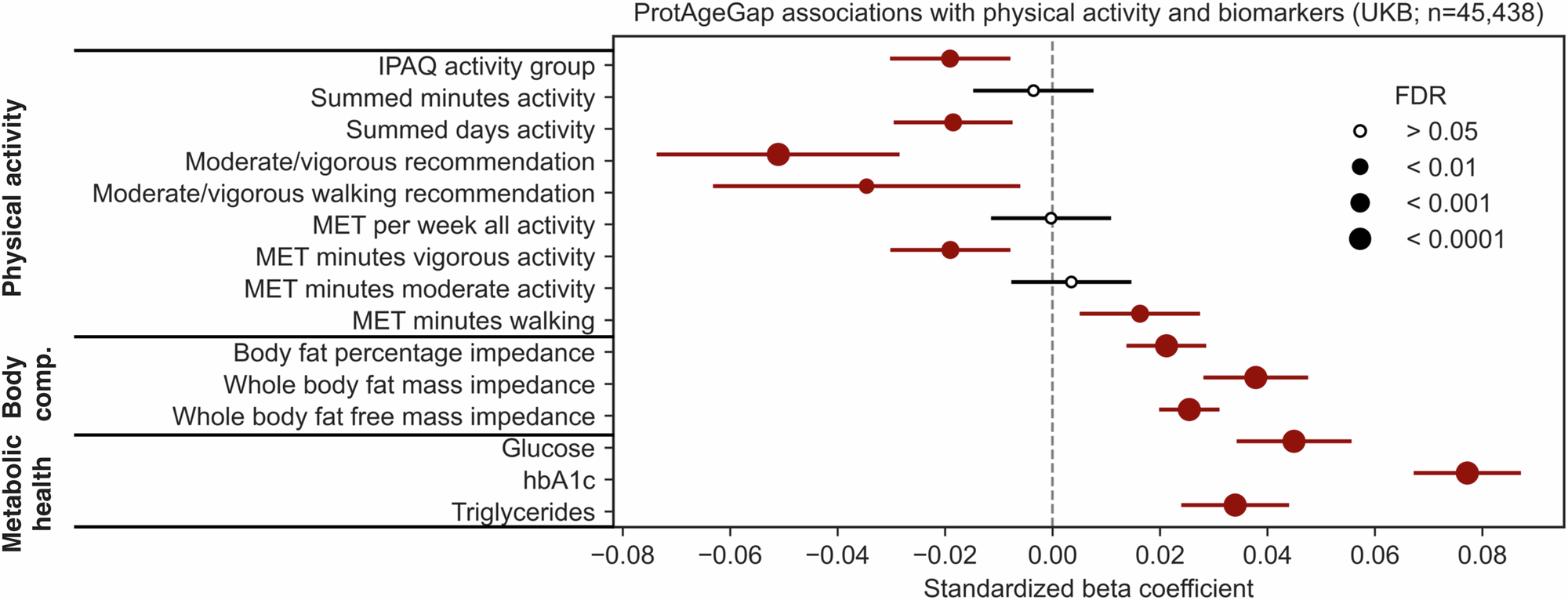
Here is the crucial nuance that got buried in the headlines: Intensity is the key. The data showed that light activity (like casual walking) was not enough to trigger these deep proteomic changes.
In fact, in the larger observational dataset, "walking" was associated with older biological age (likely because it acted as a proxy for low overall fitness).
The Big Takeaway
To signal your body to "get younger," you cannot just move; you have to demand it. The pathways that scrub old proteins (autophagy) and build new capillaries (angiogenesis) are expensive. The body only activates them when it feels the mechanical stress of resistance training or the metabolic panic of high-intensity cardio.
Biological age is an anchor, not a feather. It is stable and heavy. Making significant changes to your biological age requires intentional effort and real intensity.
⚙️ The CEO’s Protocol: My Age-Reversal Exercise System
This research, plus many other studies, have helped me refine my own longevity-oriented routines. I'm presenting my exercise protocol here not because you should copy it (everyone's needs and goals are different), but to demonstrate how to reason through building your own protocol.
Why This Split? This schedule isn't random; it is engineered for Signaling Clarity.
- Separation of Signals: I front-load mechanical tension (lifting) during the weekdays to drive growth (mTOR), and save the weekend for Rapamycin (mTOR inhibition/autophagy). This avoids the potential "interference effect" where the drug fights the workout.
- The "High-Low" Approach: I rely on high-volume low-stress movement (daily Zone 2) to maintain metabolic health, punctuated by one extreme spike of intensity (Friday's 4x4) to drive the vascular remodeling seen in the MyoGlu study.
The Daily Non-Negotiable: 7,000+ Steps
- The Baseline: I work at a treadmill desk to get 2-4 miles of "NEAT" (Non-Exercise Activity Thermogenesis).
- The Training: I dedicate an additional 20–30 minutes separate from this to deliberate Zone 2 cardio. This is my metabolic baseline—it ensures my insulin sensitivity remains high regardless of what body part I am training.
The Weekly Split
Monday: Lower Body (Posterior Chain)
- The Focus: The "Engine of Longevity." The glutes are the body’s largest glucose disposal agent. I focus on heavy hinging here to maximize GLUT4 activity (metabolic demand).
Tuesday: Upper Body Strength (Push Focus)
- The Focus: Functional strength & Bone Density. While I personally aspire to do more push-ups, the longevity goal here is loading the wrists and shoulders to prevent osteopenia.
Wednesday: Zone 2 Cardio & Core
- The Focus: A nervous system reset. Increasing mitochondrial volume without adding systemic fatigue.
- The Hack: I keep a thick yoga mat near my desk to get in "exercise snacks" (dead bugs and bird dogs) between meetings to keep the core active throughout the week. I also intentionally activate my transverse abdominus and pelvic floor, and practice breathing from my core.
Thursday: Unilateral Lower Body
- The Focus: Structural balance & Spinal Deloading. I prioritize single-leg work (like Bulgarian Split Squats). This allows me to get high muscle stimulation on the legs with half the compressive load on the spine.
Friday: The Vascular Health Engine (Back, Biceps & HIIT)
- The Focus: The critical day for "ProtAge" reversal.
- The Protocol: Norwegian 4x4 Intervals (4 minutes at 90% heart rate, 3 minutes active recovery, repeated 4 times). This high-intensity pulse is the strongest signal we have for increasing VO2 Max and capillary density (CLEC14A).
Saturday & Sunday: The Rapamycin Reset
- The Protocol: Zone 2 for 30–75 mins each day.
- The Why: I take Rapamycin on Saturday AM. Since resistance training (mTOR activation) biologically competes with Rapamycin (mTOR inhibition), I skip the weights. The weekend is dedicated purely to flow, autophagy, and recovery.
⚡ Longevity Quick Hits
👁️ FDA Clears "Age Reversal" Trial: This is the big one. Life Biosciences received FDA clearance to begin clinical trials for ER-100, a gene therapy for optic neuropathy. This isn't just slowing decline. By using "partial epigenetic reprogramming" (the Yamanaka factors), they aim to reverse the age of eye cells and restore vision. We have officially moved from "maintenance" to "reset."
📉 The "Ozempic Rebound" is Real: A new systematic review in the BMJ confirms that stopping GLP-1 drugs leads to rapid metabolic reversal. On average, patients regained ~10kg (22lbs) in the first year, with lipids and A1C returning to baseline. These are not 12-week cycles; they are metabolic prosthetics. If you start, have a "forever plan" (or a very aggressive exit strategy).
🚫 Consumer Watch: The "Noise" is getting louder. Viome's Full Body Intelligence" test is taking heat from Wired for lacking clinical utility despite the fancy RNA tech, not to mention obvious conflicts given their apparent goal is to sell more of their own supplements. Verdict: Over-measuring, under-knowing.
🫀 Until Next Week
Take a look at the "Friday" slot in your calendar right now.
Most of us treat Friday as a slide into the weekend—a "low power mode" day. But based on the MyoGlu data I shared above, "low power" is exactly what makes us age.
The data is clear: Casual walking doesn't scrub the age markers from your blood. Intensity does.
So, I’m challenging you to turn your Friday slot into a Vascular Remodeling Session.
- The Goal: 15 minutes of "metabolic panic."
- The Metric: Get your heart rate above 90% max.
- The Mindset: You aren't "working out." You are sending a survival signal to your stem cells that says: "We are still hunting. We are still useful. Do not shut down."
- The Correction: Don't go so intense that you cannot maintain 4 min at that level - back down or try another method (slower speed, higher incline, etc)
To your healthspan,
Hillary Lin, MD
Co-Founder & CEO
Follow me for more longevity insights: YouTube | LinkedIn | Instagram | TikTok
Want to turn your wellness brand into a full-service health destination? Learn about Care Core's platform or Get Started Here
Where to find me:
I'll be at the Integrative Healthcare Symposium in NYC – Feb 19-21. Let me know if you're there and we can sync up!
👱🏻♀️👩🏻🦰👩🏻👧🏽👧🏾 Livelong Women’s Health Summit – April 17-18, 2026, SF, CA. Delighted to join 50 other thought leaders in speaking on women's longevity! (Code HILLARY50 for $50 off)
Support us with your longevity purchases:
NeuroAgeTx is offering the most comprehensive and science-backed brain aging package to The Longevity Letter readers at up to 61% off (affiliate link here)
Timeline offers the patented Urolithin A for scientifically proven mitochondrial support via mitophagy. Their MitoImmune trial just published showing reversal of immune cell exhaustion in 28 days. (Code CARECORE for 10% off).
GlycanAge measures your immune system's biological age, offering an easy way to detect "inflammaging" and recommend how to fix it.
ZBiotics is one of my favorite brands, because they offer two pro-longevity probiotics for when you *do* have a little fun (alcohol or sugar!). (Code CARECORE for 10% off.)